
How I Landed My First Upwork Project and Earned $1,000 in My First Month
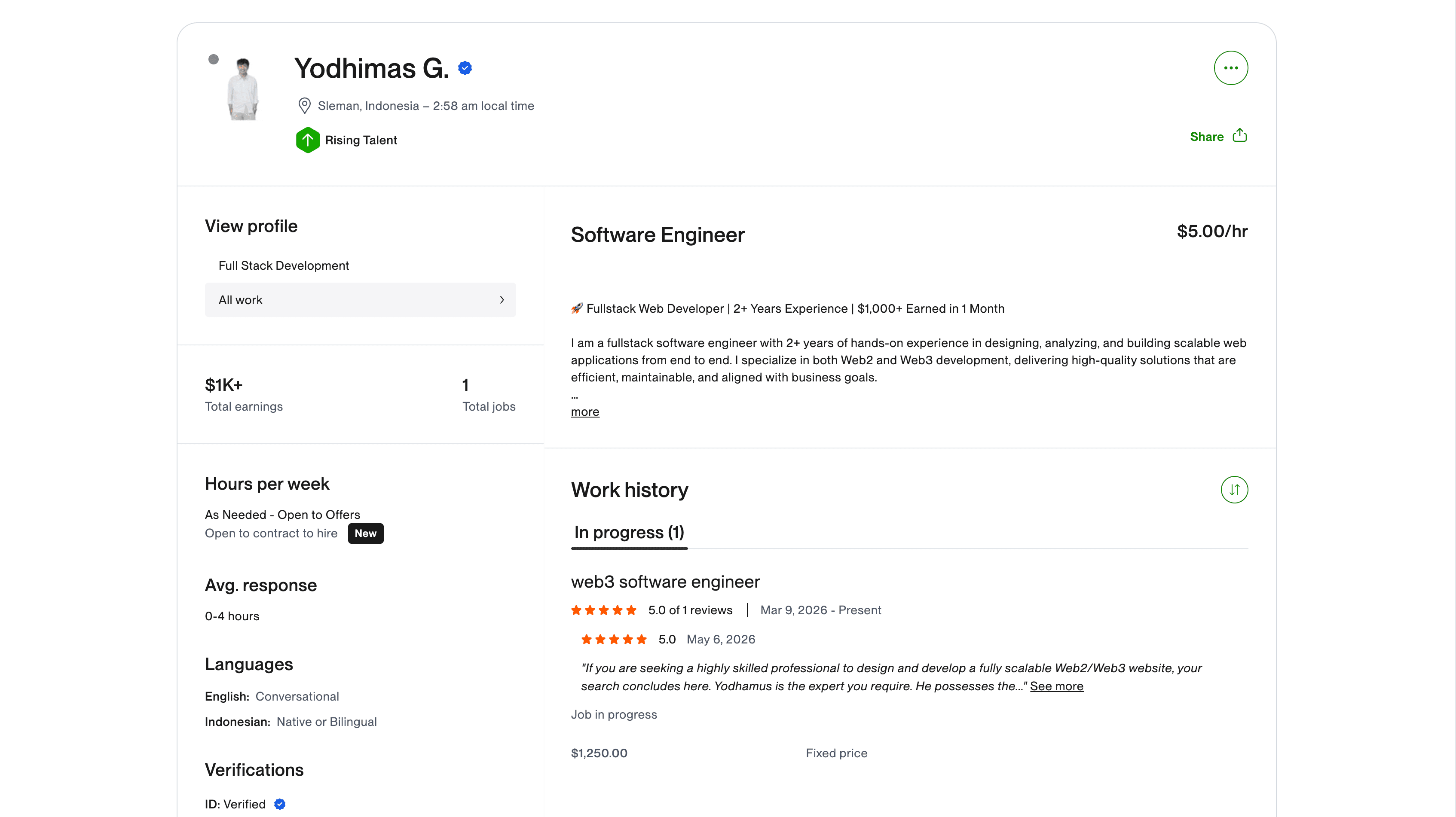
A practical breakdown of how I went from zero Upwork presence to closing my first client, earning $1,000 in a single project within my first month - and the specific strategies that made it happen.

How I Landed My First Upwork Project and Earned $1,000 in My First Month
Starting on Upwork with zero reviews, zero job success score, and zero history feels like walking into a job interview with a blank resume. Every other freelancer has a track record. You do not. The platform's algorithm does not know you exist yet.
I was in that position not long ago. Within my first month, I had closed my first project, delivered it, and earned just over $1,000 from it. The engagement is still ongoing. Here is exactly what I did, what I wish I had known earlier, and the mindset shift that made the biggest difference.
Why Most New Freelancers Fail in the First 30 Days
Before getting into tactics, it is worth naming the real reason most new freelancers quit Upwork early: they apply to the wrong jobs at the wrong time with the wrong expectations.
They see a $5,000 project that matches their skills perfectly. They write a proposal. They get no response. They try again. Still nothing. After a few weeks of silence, they conclude that Upwork is a broken, pay-to-win platform that only rewards established freelancers.
That conclusion is not entirely wrong - the platform does reward track record. But it is the wrong lesson to take from the experience. The right lesson is: you are not competing on skill yet. You are competing on trust. And trust takes proof.
The entire early-stage strategy should be oriented around building that proof as quickly as possible, not landing the biggest possible project.
Step 1: Treat Your Profile Like a Landing Page, Not a Resume
The single biggest mistake new freelancers make is writing a profile that reads like a CV - a chronological list of past jobs, technologies they know, and a generic statement about being "passionate about delivering quality work."
Your profile is not a resume. It is a sales page. The person reading it has 30 seconds and ten other tabs open. Your job is to answer one question in the first three lines: why should I hire you for the specific thing I need done?
Concrete things that move the needle:
Headline specificity. "Full-Stack Developer" competes with 80,000 people. "Next.js + .NET API Developer for Web Apps and Dashboards" is a narrower, more credible claim. When a client posts a Next.js project and sees that headline, there is immediate pattern-matching.
Overview that leads with client value. Do not start with "I am a software developer with 3 years of experience." Start with the problem you solve. "If you need a clean, fast web application built on a solid backend - one that ships on time and does not fall apart six months later - that is what I build." Then explain your background as evidence.
Skills section filled completely. Upwork's search algorithm surfaces profiles based on skills. Every skill you leave blank is a search result you do not appear in. Fill every slot with relevant, accurate skills.
Portfolio with context, not just screenshots. Anyone can upload an image of a dashboard. The question a client is asking when they look at your portfolio is: what problem did this solve, and can you do that for me? Write a two-sentence description for each piece that explains the what and the why.
Step 2: Record a Profile Introduction Video
This is the highest-leverage thing most freelancers skip because it feels awkward.
Upwork lets you record a short video introduction that appears on your profile. The majority of freelancers - including many experienced ones - do not have one. That means having a video immediately puts you in a smaller group.
More importantly, it solves the trust problem. Text claims are cheap. A video of you clearly explaining your background, what you work on, and how you approach client projects is much harder to fake. Clients who watch the video before reaching out are already more bought-in before the conversation starts.
Keep it under 90 seconds. Do not script it word-for-word - that reads as rehearsed. Have three points you want to hit: who you are, what kind of work you do best, and what working with you looks like. Decent lighting and a quiet room are enough. Production quality matters less than coming across as a real, competent human being.
Step 3: Do Not Chase the $5,000 Projects First
This is the strategy that most directly explains my first-month result.
When you have zero reviews, a client considering your proposal has to take your word for everything. Your claims about code quality, communication, reliability - all of it is unverified. For a $5,000 project with real business consequences, most clients will not take that risk on an unreviewed freelancer when there are three other candidates with 50 reviews and a 95% job success score.
The play is to make the risk calculation easy. Find projects where the stakes are low enough that a client is willing to try a new freelancer: small scope, clear requirements, defined deliverable, modest budget. $100-$500 projects. Landing page builds. Bug fixes. API integrations with clear specs.
Deliver these well. Communicate proactively. Finish on time or early. Ask for a review.
Two or three completed projects with positive reviews changes your profile completely. You now have social proof. The algorithm starts showing your profile more. Clients respond to proposals at a higher rate. You can start applying to larger projects with actual credibility behind your pitch.
The path to $1,000 projects does not start with applying to $1,000 projects. It starts with winning the $150 ones first.
Step 4: Write Proposals That Are About the Client, Not About You
Most proposals on Upwork look like this:
"Hello, I am a skilled developer with 4 years of experience in React and Node.js. I have worked on many similar projects and I am confident I can deliver quality work. Please check my portfolio and let me know if you want to discuss."
This proposal is entirely about the freelancer. It gives the client no reason to reply. It could have been sent to any job posting by anyone.
A better structure: open by referencing something specific about their project or post, demonstrate that you understand the actual problem they are trying to solve, briefly explain why your background is relevant to that specific problem, and end with a low-friction next step like a single clarifying question.
Specificity is the differentiator. If a client posts about needing a booking system integrated with Google Calendar and you open your proposal by addressing exactly that integration and the one edge case that most implementations get wrong - you have already separated yourself from 90% of the generic proposals they are reading.
Keep it short. Clients do not read long proposals. Four to six sentences is usually enough to get a reply. The goal of the proposal is a conversation, not a contract.
Step 5: First Impressions in the Interview Stage Are Everything
When a client replies to your proposal, they are evaluating two things simultaneously: whether you can do the work, and whether working with you will be pleasant.
Technical ability is table stakes. What separates candidates at this stage is communication quality. Reply promptly. Ask clarifying questions that reveal you have thought about their project. Be direct about what you can deliver, what you cannot, and what you need to succeed.
If there are risks or unknowns in their scope, name them early. Clients respect this far more than blind confidence. A freelancer who says "I can build this, but the third-party API you mentioned has rate limits that might affect the timeline - here is how I would handle it" is much more credible than one who just says "no problem, I will get it done."
Set clear expectations on deliverables, revisions, and communication cadence before work starts. The contracts that end badly almost always had scope or expectation problems that were visible in the initial conversation and ignored.
Step 6: Use the Early Days to Build, Not Just Earn
Your first three months on Upwork should be thought of as an investment phase, not a pure earnings phase.
Every project you take in this period is building one of two things: your public track record (reviews, job success score, portfolio) or your skills in client work (scoping, communication, delivery). Both compound over time.
This means it is worth taking some projects at a lower rate than your target - not permanently, and not to the point of undervaluing your work, but enough to move your profile forward when you are choosing between a guaranteed review at $150 and a gamble on a $400 project that might not respond.
It also means that when you deliver a project, you follow up. Check if there is more work. Ask if they have colleagues who need similar work. A satisfied client is a warm lead for the next project, and a referral from a client carries more weight than any cold proposal.
What YouTube Got Right (and What to Ignore)
There is genuinely useful Upwork content on YouTube. Channels that walk through real proposals, explain the search algorithm, or share actual earnings transparency have helped a lot of freelancers. Some recommendations worth watching:
- Proposal teardowns where the creator shows what they would actually send for a specific job posting
- Profile audits where an experienced freelancer reviews a new profile and explains what to change and why
- Niche-specific advice from freelancers in your field who have Upwork history
Where I Am Now
The first project led directly to an extended engagement. The client came back with more scope after the initial delivery, which is the best possible outcome - not just because of the additional income, but because a returning client is the clearest signal that you did the job right.
My profile now has reviews. The proposals I send get replies at a different rate than they did in month one. The compounding has started.
The first month is the hardest. The work is real, the returns are modest, and the silence from unanswered proposals is discouraging. But if the fundamentals are in place - a clear profile, specific proposals, small projects taken seriously - the track record builds faster than it feels like it will from the inside.
Start smaller than you think you should. Deliver better than you think you need to. The bigger projects will come.
Comments
No comments yet. Be the first!